A USPTO Notice of Allowance usually arrives as a plain PDF in Patent Center, after years of office actions, amendments, and invoices. Take a moment to enjoy it. You earned it.
Then read the date in the top corner. The examiner has approved your claims, but you do not have a patent yet. To get one, you must pay the issue fee (the USPTO’s charge to grant and publish your patent) and file any corrected drawings or other items the notice requires, all within three months of that mailing date. The deadline cannot be extended. Miss it, and the application is abandoned.
One more decision belongs before payment. If you may want broader or different claims later, file a continuation now, because that door closes once the patent issues.
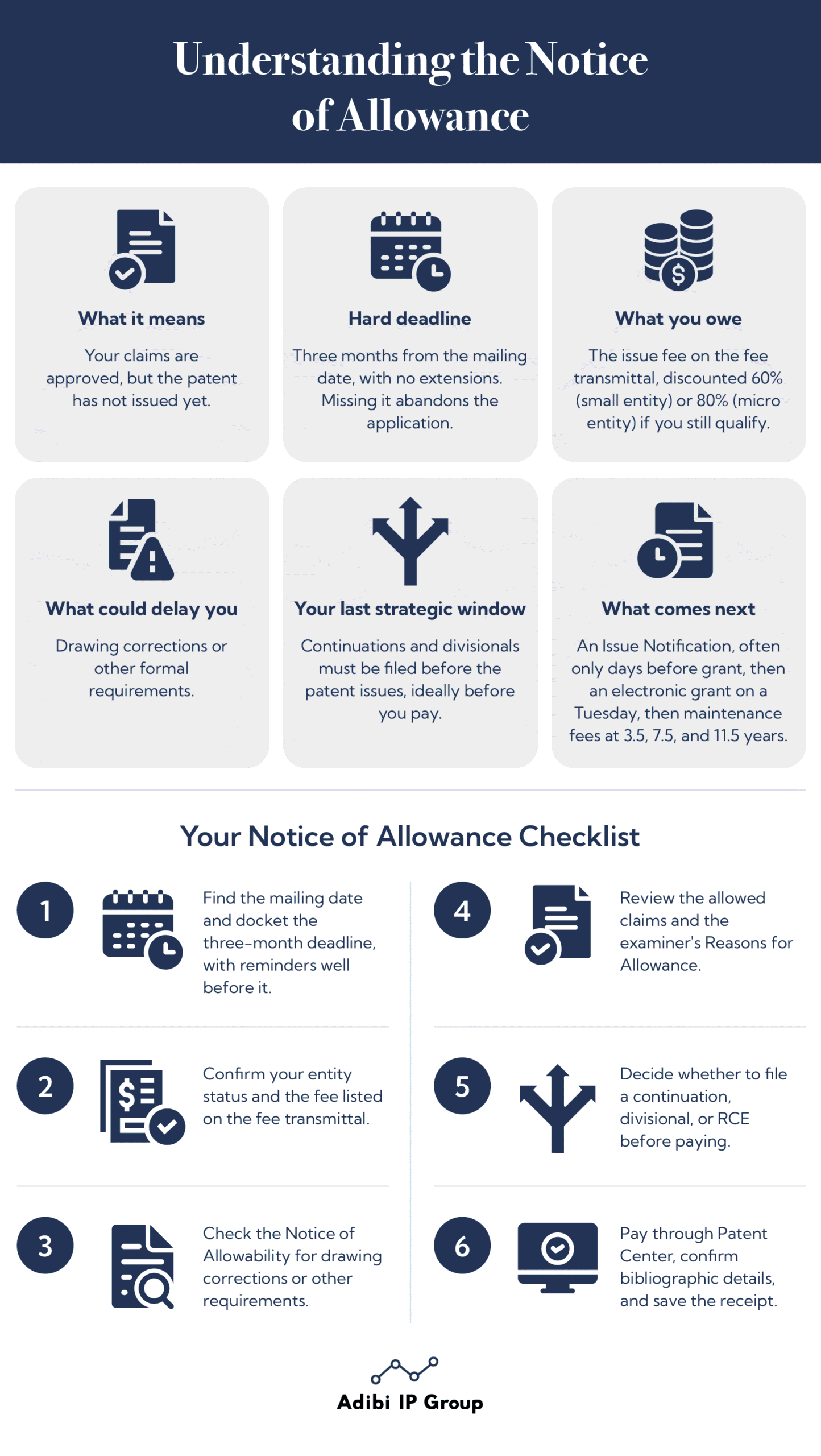
Key Takeaways
- What the Notice of Allowance means: Your claims are approved, but the patent has not issued yet.
- Hard deadline: Three months from the mailing date, with no extensions. Missing it abandons the application.
- What you owe: The issue fee on the fee transmittal, discounted 60% (small entity) or 80% (micro entity) if you still qualify.
- What could delay you: Drawing corrections or other formal requirements.
- Your last strategic window: Continuations and divisionals must be filed before the patent issues, ideally before you pay.
- What comes next: An Issue Notification, often only days before grant, then an electronic grant on a Tuesday, then maintenance fees at 3.5, 7.5, and 11.5 years.
Notice of Allowance Checklist: What You Need To Do Right Now
- Find the mailing date and docket the three-month deadline, with reminders well before it.
- Confirm your entity status and the fee listed on the fee transmittal.
- Check the Notice of Allowability for drawing corrections or other requirements.
- Review the allowed claims and the examiner’s Reasons for Allowance.
- Decide whether to file a continuation, divisional, or RCE before paying.
- Pay through Patent Center, confirm bibliographic details, and save the receipt.
Not sure whether your deadline, fee, or claims are right? Contact us for a quick post-allowance review.
Before you act on any of it, it helps to know exactly what the notice is, and what it is not.
What Is a Notice of Allowance and Why It Matters in Patent Prosecution
The Official Definition and What It Means Legally
The Notice of Allowance and Fee(s) Due (form PTOL-85) is the USPTO’s formal statement that your application has passed examination and will issue as a patent once you pay the issue fee (35 U.S.C. 151; 37 CFR 1.311). The examiner has concluded that your invention is new, non-obvious, and adequately described. The post-allowance phase, governed by MPEP Chapter 1300, now begins.
Allowance is not a granted patent. No enforceable rights exist until the grant date.
Nor is allowance the same as an office action finding “allowable subject matter,” which is conditional on you amending or responding.
The notice usually arrives with a companion, the Notice of Allowability (form PTOL-37) (MPEP 1302.03). The Notice of Allowance tells you what to pay and by when. The Notice of Allowability lists the allowed claims and anything else the USPTO still needs, such as corrected drawings.
Where Allowance Falls on the Patent Prosecution Timeline
Allowance is the last milestone of prosecution, the back-and-forth between you and the examiner over office actions and amendments. Getting here usually takes years, and the time varies widely by technology area and USPTO backlog (USPTO Patents Dashboard).
Allowance ends the argument over patentability.
What the Notice Actually Contains
| Document component | What to check |
| Mailing date | It starts your three-month clock. Docket it immediately. |
| Issue fee due | Confirm it matches your current entity status. |
| Part B – Fee(s) Transmittal (PTOL-85 Part B) | Check the assignee name and correspondence details that will print on the patent. |
| Allowed claims (Notice of Allowability) | Confirm the claim numbers and wording, and note any cancelled or withdrawn claims. |
| Examiner’s Amendment (if any) | Read every word. The examiner may have changed claim language. |
| Reasons for Allowance (if any) | Note how the examiner describes what makes your invention patentable. |
| Drawing and other requirements | List each item due with the issue fee. |
For founders: In investor decks and data rooms, call these claims “allowed, pending issuance,” not “patented.” Diligence teams often check.
Knowing what the notice is leads straight to the urgent question: how much you owe, and by when.
Decoding the Critical Deadlines and Fee Requirements After Allowance
The Three-Month Statutory Deadline and How to Meet It
You have three months from the mailing date printed on the notice to pay (35 U.S.C. 151; 37 CFR 1.311). The clock starts on that date, not the day the notice reached your inbox. Unlike most USPTO deadlines, this issue fee deadline cannot be extended (MPEP 1306).
If it passes unpaid, the application is abandoned. A petition to revive for unintentional delay (37 CFR 1.137; 35 U.S.C. 27) may rescue it, at added cost, delay, and uncertainty, but a deliberate choice not to pay doesn’t qualify. Treat revival as a safety net, never a plan.
The fix is ordinary docketing, done early:
- Calendar the deadline the day the notice arrives, with reminders at intervals such as 30, 14, and 7 days.
- Name one person responsible for confirming payment.
- Pay well before the last day.
Breaking Down the Issue Fee: What You Owe and How to Confirm It
Your notice of allowance issue fee depends on your entity status, the size category the USPTO uses to set fees:
| Entity status | Who typically qualifies | Fee reduction | What to verify |
| Large entity (undiscounted) | Companies over 500 employees, or anyone who has assigned, licensed, or is obligated to transfer rights to one | None | Nothing to claim; pay the full fee. |
| Small entity | Individuals, businesses with 500 or fewer employees (including affiliates), universities, and nonprofits | 60% | No assignment, license, or obligation to a large entity. |
| Micro entity | Small entities that also meet USPTO income and prior-filing limits, or qualifying university-based applicants | 80% | The income cap and filing limits still apply today. |
Fees change periodically, so confirm the current amount on the USPTO fee schedule and pay what the fee transmittal lists. The pre-grant publication fee has been $0 since January 1, 2014, so no separate publication charge is normally owed.
Re-check your entity status before you pay. Small entity status carries through prosecution, but you must confirm you still qualify before paying the issue fee (37 CFR 1.27(g)). A license to a larger company, an acquisition, or a large-entity investor can each end eligibility, and a false claim of entitlement can draw a fine of at least three times the shortfall (35 U.S.C. 41(j)). Correcting status now usually costs far less than defending it later.
How to Submit the Issue Fee Payment Without Procedural Errors
Pay electronically through Patent Center, the USPTO’s filing system, using the Fee(s) Transmittal (PTOL-85 Part B). The instant acknowledgment receipt is your evidence of timely payment (37 CFR 1.8(b)(3)).
How to pay in Patent Center:
- Sign in with your USPTO.gov account and open the application.
- Start a new submission and choose issue fee payment.
- Complete the Fee(s) Transmittal, confirming assignee and correspondence details.
- Confirm your entity status and the fee shown.
- Pay by deposit account, card, or electronic funds transfer.
- Save the acknowledgment receipt with your docket.
Slow down at the assignee field. Whatever you enter prints on the face of the patent. If your company isn’t already the named applicant, leaving it blank means the patent won’t show it as owner (MPEP 307), a gap acquirers notice. Inventor name corrections need a separate request under 37 CFR 1.48.
For IP managers: Give post-allowance work its own docket entry. A non-extendable deadline shouldn’t sit beside routine response dates.
Payment is only part of what the notice may require. The drawings and the examiner’s stated reasons deserve the same care.
Responding to Drawing Formality Requirements and Examiner’s Reasons for Allowance
Understanding Drawing Corrections Required Before Issuance
The Notice of Allowability may require corrected drawings, sometimes attaching a Notice of Draftsperson’s Patent Drawing Review that lists each problem. Corrections are generally due within the same three-month, non-extendable period, and late drawings can delay issuance or lead to abandonment (37 CFR 1.85(c)).
The fixes are usually mechanical (37 CFR 1.84):
- Make lines dark, crisp, and reproducible.
- Keep reference numerals consistent across figures and with the specification.
- Keep margins within USPTO limits.
- Number figures in sequence (“FIG. 1,” “FIG. 2”).
- Mark each corrected page as a replacement sheet.
- Fix form only. Add no new technical content.
For more detail, see our guides to patent drawing best practices and common drawing rejections.
How to Interpret and Strategically Use the Examiner’s Reasons for Allowance
Reasons for Allowance are the examiner’s short explanation of what set your invention apart from the prior art (the earlier patents and publications it was compared against). They become part of the prosecution history, the public record a court or licensee may read when deciding what your claims cover.
You may comment on them under 37 CFR 1.104(e), no later than your issue fee payment. USPTO guidance (MPEP 1302.14) says silence is not agreement, but a short, accurate comment removes doubt.
Hypothetical: Your claim covers “a sensor coupled to the lock housing.” The examiner writes that it was allowed because of “a fingerprint sensor mounted inside the deadbolt.” Years later, a competitor with an external sensor quotes that sentence. A two-sentence statement now, noting that the claims speak for themselves and aren’t limited to that description, keeps the record clean.
The reasons also show what the examiner treated as essential. That is often a map of what your patent leaves uncovered, and it leads to the most valuable decision in this window.
Strategic Decisions and Continuation Opportunities Before the Patent Issues
Why the Post-Allowance Window Is Your Last Opportunity to Expand Patent Protection
Once the patent issues, this application can produce no new claims unless a related application is already pending. Whatever you disclosed but didn’t claim becomes, in effect, a gift to the public. So hold the allowed claims next to your market:
- Competitors: Do the claims cover what they ship today?
- Your roadmap: Do they cover what your next version adds?
- Workarounds: Could a simple design change avoid them?
Each gap can be a candidate for a continuation. A patent portfolio analysis answers these questions systematically.
Mind the timing. The legal cutoff is the issue date itself (MPEP 211.01(b)), but since electronic grants began on April 18, 2023, the Issue Notification often posts only days before a Tuesday grant. The USPTO itself recommends filing continuing applications before paying the issue fee (MPEP 1306.03).
If you’d like a claims-versus-market review before you pay, contact us.
Filing Continuation, Divisional, or Continuation-in-Part Applications Before Issuance
A continuation application keeps your original specification and filing date while you pursue new claims, often aimed at products that appeared after you filed. It must be filed while the parent is still pending (35 U.S.C. 120). A divisional application pursues an invention the examiner split off during examination and has the same deadline. A continuation-in-part (CIP) adds new material, and only the content common to both applications keeps the earlier priority date.
Since January 19, 2025, continuing applications filed more than six years after the family’s earliest benefit date carry an extra USPTO fee, with a higher tier after nine years (37 CFR 1.17(w)). For older families, that favors filing now.
| Filing type | What it does | New matter allowed? | Priority date | Best used when |
| Continuation | Pursues new claims on the same disclosure | No | Parent’s date | You want broader or different coverage of what you disclosed |
| Divisional | Pursues claims split off during examination | No | Parent’s date | You want the invention the examiner set aside |
| Continuation-in-Part | Adds new disclosure | Yes | Parent’s date for old matter, CIP date for new | You have improved the invention since filing |
| RCE | Reopens examination of this application | No | Unchanged | The examiner must consider amendments, arguments, or new prior art |
Requesting Continued Examination Versus Allowing the Application to Issue
A request for continued examination (RCE) withdraws the application from allowance and reopens prosecution. Before you pay, you can simply file one. After you pay, the RCE also needs a petition to withdraw from issue, which the USPTO must actually grant before the patent issues (37 CFR 1.313(c)–(d)).
If the only problem is newly found prior art, there is a lighter route. The USPTO’s Quick Path Information Disclosure Statement (QPIDS) program, now permanent, lets the examiner review it after payment; if nothing requires reopening prosecution, a corrected Notice of Allowability issues and the patent proceeds.
| Let it issue if… | Consider an RCE or continuation if… |
| The claims cover your product and competitors’ likely designs. | The claims are narrower than your commercial needs. |
| You need an issued patent soon for fundraising, licensing, or enforcement. | You’ve found prior art the examiner hasn’t seen. |
| The Reasons for Allowance don’t meaningfully narrow your claims. | A simple design change would avoid the claims. |
| A continuation will carry broader claims forward. | You want to keep arguing for claims rejected earlier. |
Founders should ask whether these claims cover what a competitor would actually build. IP managers should weigh each filing’s cost against its role in the family. Often the answer is both: let these claims issue, and keep a continuation pending.
With those decisions made and the fee paid, what remains is mostly administrative, with a few checks that still matter.
What Happens After the Issue Fee Is Paid: From Allowance to Issued Patent
The USPTO’s Internal Processing Steps Between Payment and Patent Grant
After payment, the USPTO assigns a patent number and issue date and posts the Issue Notification in Patent Center, usually the Wednesday or Thursday before grant. Patents issue on Tuesdays as electronic grants, and the Official Gazette publishes weekly on Tuesday. The electronic grant in Patent Center is the official patent. Enroll in the USPTO’s e-Office Action program so the Issue Notification reaches you by email.
When the Issue Notification arrives, verify the patent number, issue date, assignee, and patent term adjustment. After grant, update investor materials and mark products with “Pat.” and the number, or use virtual marking on a web page (35 U.S.C. 287).
Enforceable rights begin on the patent grant date. If your application was published, you may also be owed a reasonable royalty for pre-grant use of the invention, provided the issued claims are substantially identical to the published ones and the user had actual notice of the publication (35 U.S.C. 154(d)).
Understanding Patent Term and How the Allowance Timeline Affects It
A utility patent generally lasts 20 years from its earliest effective U.S. non-provisional filing date, not from grant, so years in prosecution come out of the term (35 U.S.C. 154(a)(2)).
Patent term adjustment (PTA) adds back days for certain USPTO delays and subtracts days for yours, such as late office action responses. Review the PTA figure on the Issue Notification as soon as it posts. Requests for reconsideration are due within two months of grant, extendable by up to five months for a fee (37 CFR 1.705), and an error can cost exclusivity at the end of the term, often its most valuable stretch.
Planning for Post-Issuance Maintenance Fees to Preserve Patent Rights
Utility patents require patent maintenance fees three times after grant, each larger than the last and well above the issue fee. Budget for them now.
| Maintenance fee | Window opens | Due | Grace period ends (with surcharge) |
| First | 3 years after grant | 3.5 years | 4 years |
| Second | 7 years after grant | 7.5 years | 8 years |
| Third | 11 years after grant | 11.5 years | 12 years |
If the six-month grace period ends unpaid, the patent expires. A petition to accept delayed payment may still be possible if the delay was unintentional (35 U.S.C. 41(c)), but don’t rely on it. Docket all three dates the day your patent issues, and check current amounts on the USPTO maintenance fees page.
Notice of Allowance FAQs
Is a Notice of Allowance the same as a patent?
No. The examiner has approved your claims, but the patent exists only after you pay the issue fee, meet any remaining requirements, and the USPTO grants it. Until then, describe your claims as “allowed, pending issuance.”
Can I get an extension on the issue fee deadline?
No. The three-month period from the notice’s mailing date cannot be extended, and extension-of-time petitions don’t apply. Docket the deadline immediately, set reminders, and pay early rather than on the final day.
What happens if I miss the issue fee deadline?
The application is abandoned. You may be able to revive it with a petition for unintentional delay (37 CFR 1.137), but revival adds fees, delay, and uncertainty. If the date has passed, contact counsel promptly, because further delay makes revival harder.
Can I still file a continuation application after paying the issue fee?
Yes, as long as the patent hasn’t issued. But under electronic grants, the Issue Notification often posts only days before the Tuesday grant, so the window can close quickly. The safest approach is to file before or alongside your issue fee payment.
How long after paying the issue fee will my patent issue?
There is no fixed timeline. Once a patent number and issue date are assigned, the Issue Notification usually posts the Wednesday or Thursday before the Tuesday grant. Watch Patent Center after paying, and enroll in e-Office Action for email alerts.
Can I change the assignee or correspondence address before the patent issues?
Yes. Use the Fee(s) Transmittal (PTOL-85 Part B) to confirm or correct the assignee name and correspondence details that will print on the patent, and make sure the assignment is recorded with the USPTO. Inventor name corrections need a separate request.
Your Next Steps Toward an Issued Patent
Allowed is not yet patented. Your Notice of Allowance starts a non-extendable three-month deadline between you and the grant, and that same window is your last chance to file follow-on applications.
- Docket your deadline today, using the mailing date on the notice.
- Confirm your fees, entity status, and any drawing requirements.
- Review your allowed claims and decide on continuations before you pay.
Handle those three, and the rest is largely the USPTO’s work: a number, a Tuesday grant, and a patent you can stand behind. Adibi IP Group can confirm your deadline and fees, review your allowed claims against your market, and file any continuation before the patent issues. You’ve done the hard work of earning allowed claims. Let’s make sure they become the patent, and the portfolio, your business needs. Contact us to schedule a post-allowance review.